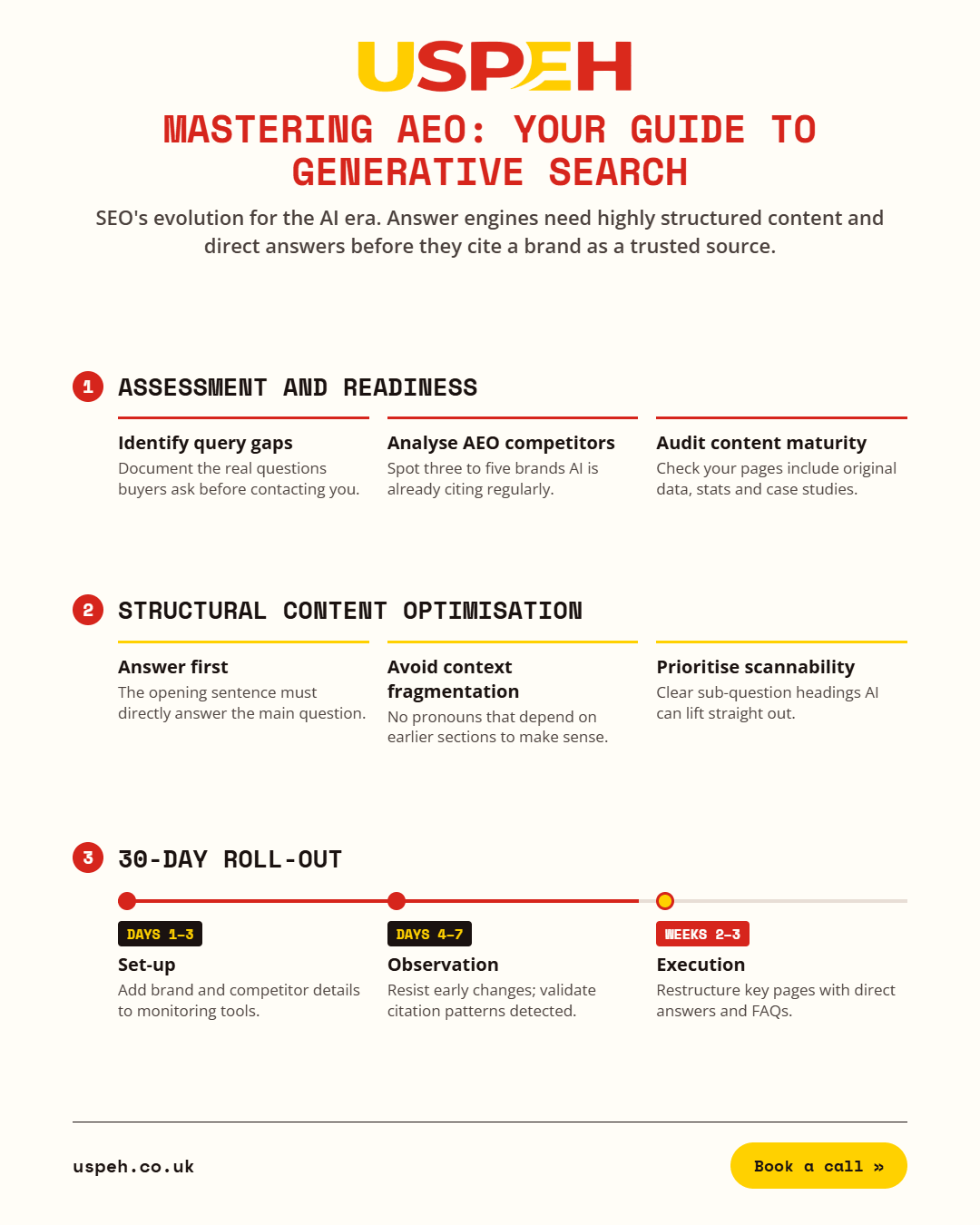
When buyers ask ChatGPT, Gemini, Perplexity, or Google’s AI-led search experiences a question, they are no longer browsing search results in the way they once did. Increasingly, they are receiving a synthesised answer.
That change matters for any business that depends on being discovered, understood, and shortlisted during research. If your brand is absent from those answers, mischaracterised in them, or cited less often than competitors, you may be losing influence before a prospect ever reaches your website.
That is where Answer Engine Optimisation (AEO) comes in.
AEO is the discipline of improving how your brand, expertise, and content appear in AI-generated answers. It does not replace SEO. It builds on it. Traditional SEO still matters because authoritative, well-performing pages remain strong candidates for citation and summarisation. But AEO adds a new layer: making your content easier for answer engines to interpret, extract, trust, and reuse in context.
For teams already using HubSpot, the opportunity is especially strong. HubSpot now provides resources and tools that help businesses move from a general understanding of AEO into practical execution: assessing visibility, evaluating how a brand is represented in AI-generated outputs, identifying opportunities, and creating a repeatable operating rhythm around improvement.
In this blog post, we explain what AEO is, why it matters now, and how to do AEO with HubSpot in a way that is commercially useful rather than merely fashionable.
Answer Engine Optimisation is the practice of improving your visibility in AI-generated answers.
Instead of focusing only on where a page ranks in search results, AEO focuses on whether your brand and content are surfaced when someone asks an AI tool a relevant question.
For example, a prospective buyer may ask:
In each case, the answer engine may provide a direct response that references brands, explains approaches, and cites sources. The brands that appear in those answers are not there by accident. They are more likely to have:
AEO therefore sits at the intersection of content strategy, technical structure, brand authority, and measurement.
AEO and SEO are closely related, but they are not identical.
SEO is still concerned with discoverability in search engines, organic traffic, crawlability, and rankings. AEO extends that work into AI-led discovery environments where users may never click through in the first place.
A simple way to think about it is this:
That distinction matters because a page can rank reasonably well and still be poorly suited to AI retrieval. If the page buries the answer, relies heavily on implied context, or lacks clear section structure, an answer engine may struggle to lift the right passage cleanly.
Likewise, a business can publish a large volume of content and still underperform in AI visibility if that content does not reflect the way buyers ask questions, compare options, and evaluate vendors.
There are three reasons AEO has moved from emerging topic to practical priority.
People are using AI tools to research categories, compare vendors, summarise options, and sense-check decisions. That means the discovery journey is increasingly happening inside answer engines, not only on search results pages.
A prospect can now form a first impression of your business without visiting your site. If answer engines describe your company inaccurately, omit it entirely, or favour a competitor in comparison-style queries, that directly affects consideration.
Answer engines do not consume content the same way a human reader does. They extract, compare, and recombine passages. That means content needs to be easier to parse, easier to quote, and easier to understand in smaller chunks.
This is one of the most important operational shifts in AEO. Content that is strong for a person is not automatically strong for an answer engine. If a section only makes sense because of context supplied much earlier on the page, the extracted answer may lose clarity. If the key response appears halfway down a long introduction, the page becomes harder for AI systems to use confidently.
HubSpot’s approach to AEO is helpful because it turns a vague idea into something more measurable and actionable. Instead of treating AEO as an abstract trend or a loose collection of “AI visibility” tactics, HubSpot breaks it down into concrete steps you can define, track, and improve over time. It gives you shared language, data points, and workflows so that AEO can sit alongside your existing SEO, demand generation, and RevOps activity, rather than living as a side project no one quite owns.
At a practical level, HubSpot provides resources and tools that support several parts of the AEO workflow, from education through to execution and ongoing optimisation. You can upskill your team on what AEO is and how it works, benchmark how answer engines currently describe and surface your brand, and then link that insight directly to content, campaigns, and CRM data inside HubSpot. In other words, it is not just theory. The platform helps you move from “we know AEO matters” to “we have a repeatable process to improve how we appear in AI-generated answers, and we can see how that ties back to visibility, pipeline, and revenue.”
If you want support turning that capability into a concrete plan, uspeh delivers AEO services directly inside HubSpot, from assessment and strategy through to implementation and ongoing optimisation. Talk to us about AEO in HubSpot and we’ll help you design a practical program tailored to your portal, content, and growth goals.
HubSpot Academy now offers AEO learning paths that distinguish between understanding the discipline and implementing it inside HubSpot. That matters because many teams first need a shared strategic model before they can operationalise anything.
HubSpot’s AEO Grader provides a snapshot of how answer engines characterise a brand, including dimensions such as sentiment, presence quality, recognition, share of voice, and market positioning.
For many businesses, this is the right starting point because it helps answer a foundational question: how are answer engines representing us today?
HubSpot’s broader AEO tooling supports ongoing tracking rather than one-off analysis. That is important because AI visibility is not static. Results can vary by platform, context, and time. The goal is therefore not to obsess over one response, but to monitor directional movement over time.
Resources such as AI Search Sensor help teams understand broader shifts in AI-referred traffic, citation patterns, and answer engine volatility. While that type of benchmark data does not replace brand-level measurement, it gives context for what may be happening in the wider landscape.
Even beyond dedicated AEO tooling, HubSpot can support the operational side of AEO through content production, campaign coordination, reporting, and conversion tracking. In practice, that means your AEO work does not need to live in a disconnected spreadsheet. It can connect to your wider demand generation and CRM processes.
If you want to implement AEO in a sensible way, avoid treating it as a one-off content refresh. Instead, build it as a repeatable process.
Before you optimise anything, establish where you stand.
This means looking at three things:
HubSpot’s AEO Grader can help with the first stage of diagnosis at brand level, while HubSpot Academy’s implementation approach reinforces that you should assess readiness before jumping into tactical changes.
This baseline matters because not every business has the same problem.
Those are different problems, and they need different implementation plans.
Traditional keyword research still has value, but AEO requires a stronger understanding of how real people phrase problems, concerns, and evaluation criteria.
That means looking beyond high-volume phrases and asking:
This is where commercial teams and marketing teams need to work together. Good AEO is rarely produced in isolation by content alone. It depends on buyer language.
In HubSpot, this can be operationalised by using sales call notes, conversation themes, forms, CRM data, and campaign insights to identify the questions that matter most at awareness, consideration, and decision stage.
One of the most practical AEO lessons is that pages already performing well in organic search are often strong candidates for AI visibility improvement.
Why? Because you are not starting from zero. You already have a page with some degree of relevance and authority. The task becomes making it easier for answer engines to use.
That means reviewing high-potential pages such as:
For uspeh, for instance, that could cover pages tied to HubSpot migration, onboarding, optimisation, AI enablement, and AEO services.
This is where many AEO improvements become tangible.
To make content more answer-engine friendly, structure it so that the primary question is answered early and clearly. Do not force the reader, or the AI system, to wait several paragraphs before reaching the point.
Useful principles include:
In other words, write so that a section can be extracted without becoming confusing.
Answer engines do not just reward brevity. They also need substance.
If your site only repeats generic guidance, it is harder to become a trusted source. Stronger AEO content often includes:
AEO content should educate first, but it should not stop at generic education.
If your content explains a challenge clearly but never connects that challenge to your service, you may win visibility without commercial value. The best AEO content helps answer engines understand not only what you know, but what you do.
That does not mean turning every paragraph into a sales pitch. It means creating a clear bridge between the insight and the service.
We can share a practical example from our own business:
AEO should be treated as an ongoing optimisation cycle.
That means creating a regular rhythm for:
HubSpot is useful here because it can support the operational cadence around this work, not just the initial diagnosis.
The key is to think in trends, not absolute perfection. Early AEO data will fluctuate. What matters more is whether you are appearing more consistently, in more commercially relevant queries, and with more accurate positioning over time.
As interest in AEO grows, so does the risk of superficial implementation. Here are some of the most common mistakes.
It is not. If your technical foundations, topical authority, and content quality are weak, AEO will struggle too.
Not every query matters equally. Focus on the questions buyers ask during genuine evaluation, not just broad informational prompts with little buying intent.
Another company’s benchmark is not your strategy. Your goals should reflect your market, category dynamics, business model, and commercial priorities.
Answer engines do not need another vague article about the future of search. They need useful, structured, source-worthy content that answers specific questions well.
AI visibility can vary significantly in the short term. Build a 30-day view, refine your configuration early, then assess patterns rather than reacting to every fluctuation.
Many businesses do not need more theory about AEO. They need a practical implementation partner who can connect the strategy to delivery inside HubSpot.
That is where uspeh’s AEO consultancy and implementation services come in.
We help businesses:
Most importantly, we approach AEO as part of a broader HubSpot growth system, not a disconnected experiment. That means the work can be tied back to visibility, demand generation, and commercial outcomes.
If you want a more structured route into AEO, explore our Answer Engine Optimisation (AEO) Services page and speak to us about implementation support tailored to your content, HubSpot setup, and growth priorities.
AEO is not a gimmick and it is not simply a rebrand of SEO. It reflects a real change in how buyers discover and evaluate brands.
For HubSpot users, the advantage is that there is now a clearer path from education to execution. You can use HubSpot tools to understand the discipline, assess how answer engines currently represent your brand, and build an ongoing process for improvement.
The businesses that do this well will not just publish more content. They will publish more useful, better structured, better connected content — and they will measure whether that work improves how they appear in AI-generated answers.
That is the real goal.
Not just more content.
Not just more rankings.
But better visibility where modern buying decisions are increasingly being shaped.
If you want to understand how your brand currently appears in AI-generated answers, identify where competitors are winning, and build a practical implementation plan inside HubSpot, uspeh can help.
Explore our Answer Engine Optimisation (AEO) Services page to see how we support audits, implementation, optimisation, and ongoing consultancy.
Sources consulted